
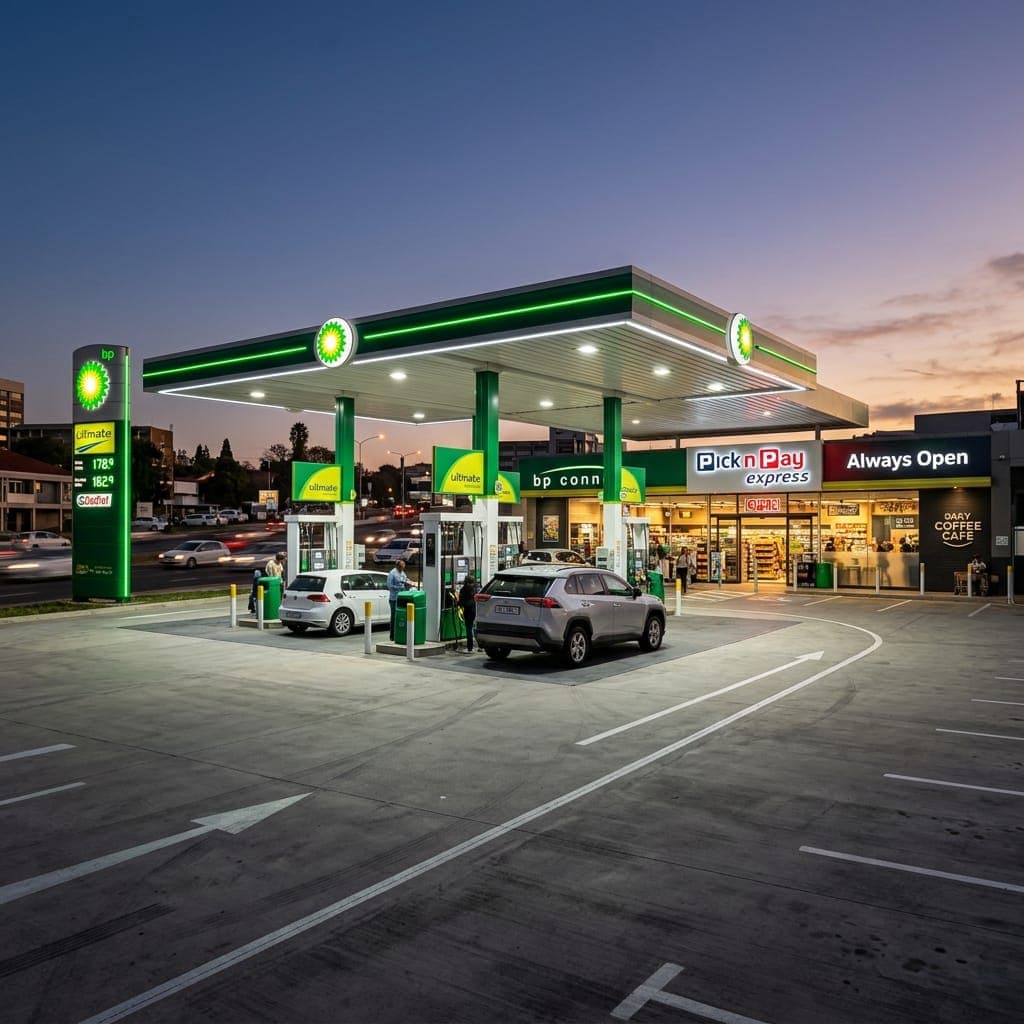
A convenience store on a filling station's premises does not automatically fall under MIBCO's scope, common ownership and shared premises are not enough. The Labour Court confirmed this on 15 June 2026 in Merriman BP Service Station (Pty) Ltd v MIBCO, setting aside an arbitrator's award that had brought a Pick n Pay Express store into MIBCO purely because it was owned by the same company as the BP filling station next to it.
What actually decides the question is operational integration: shared accounting, shared staff, shared point-of-sale systems. If you run a forecourt with a co-located store, car wash, or other tenant business, this judgment is the current legal test you need to apply.
Common ownership does not put a business under MIBCO. Shared premises does not put a business under MIBCO. The test is whether the two operations are actually run as one and the Labour Court just said so in the clearest terms it has used on this point in years.
The case is Merriman BP Service Station (Pty) Ltd v Motor Industry Bargaining Council (Western Cape) and Others (C04/2021) [2026] ZALCCT 94, handed down on 15 June 2026 by Judge Lagrange in the Labour Court, Cape Town.
The full judgment is available on SAFLII, the free public repository for South African case law.
If you're a filling station operator running a Pick n Pay Express, a Spar Express, a car wash, a tyre bay, or any other business on the same forecourt, this judgment sets the test you'll be measured against and it directly interprets Clause G (numbered item 7 in the current agreement's definitions) of the current MIBCO Main Agreement (2025–2028), the same provision that applies to your business today.
What Was the Dispute About?
Merriman BP Service Station (Pty) Ltd operates a BP-franchised filling station in Stellenbosch. On the same premises, under the same corporate entity, it also runs a Pick n Pay Express convenience store.
An arbitrator at the CCMA had earlier ruled that the Express store's employees fell within MIBCO's registered scope. Merriman took that ruling on review.
- Both businesses were owned by the single legal entity, Merriman (Pty) Ltd.
- Both operated on the same physical premises.
- Both were franchise operations: BP for fuel, Pick n Pay for the store.
- The Pick n Pay till system could not process fuel payments, and vice versa.
The arbitrator found that because both businesses were part of one company, and because the store "supported" the filling station, the Express store's staff fell under MIBCO. Merriman disagreed, and the matter went to the Labour Court.
This is exactly the kind of scope question ThreeOneSolutions helps motor industry employers resolve before it becomes a CCMA dispute.
What Does the MIBCO Main Agreement Actually Say About Forecourt Convenience Stores?
The dispute turned on the interpretation of a single provision within MIBCO's registered scope, referred to throughout the judgment, and commonly in MIBCO compliance practice, as "Clause G" (or "paragraph g)").
In the current MIBCO Main Agreement (2025–2028), this provision sits within Division A, Clause 2: Definitions, under the definition of "Motor Industry" - numbered as item 7 in that definition's list, though the substance is identical to what the court calls Clause G:
"...the business conducted by filling and/or service stations including ancillary activities forming part of a service station linked to the convenience store environment inclusive of the preparing, serving and selling of food/beverages to customers but excluding activities of separately registered establishments whose sole activities relates to the restaurant, tearoom and catering environment."
Two phrases carried the whole case: "ancillary activities" and "separately registered establishments." Get those two phrases wrong, and you'll either register a business that doesn't belong in MIBCO, or leave one out that does.
A naming note for anyone searching for this clause directly: Clause G is listed as item 7 in the numbered "Motor Industry" definition, not as a lettered sub-clause, in the current agreement but "Clause G" remains the standard shorthand used in demarcation proceedings.
Don't confuse it with the unrelated occupation code "G" (Supply Salespersons) listed in Annexure E of the same agreement, that's a wage classification code, not a scope provision, and has nothing to do with this judgment.
Why Did the Arbitrator Get It Wrong?
The arbitrator's award rested on two errors of law. The Labour Court corrected both.
Does Common Ownership Put a Business Under MIBCO?
No. The arbitrator treated the fact that both businesses were owned by the same company, Merriman (Pty) Ltd, as the deciding factor. The Labour Court rejected this outright.
Judge Lagrange pointed out the absurd consequence of that reasoning: if Merriman had simply held the BP franchise and the Pick n Pay franchise in two separate subsidiary companies instead of one, the arbitrator's own logic would have produced the opposite result, the store would have fallen outside MIBCO.
A demarcation outcome that changes based on how you structure your holding companies, rather than what the business actually does, cannot be the correct legal test. The clause refers to "establishments," not companies or employers.
At ThreeOneSolutions, we audit wage schedules and scope questions against the 2025–2028 Main Agreement every day, corporate structure is one of the most common false assumptions we correct.
Does "Separately Registered" Mean Separately Incorporated?
No. The arbitrator read "separately registered establishments" to mean separately incorporated companies. Because the Pick n Pay store wasn't its own registered company, he found the exclusion didn't apply.
The court found this interpretation untenable. Consider a sole trader running a standalone tearoom on a forecourt, a sole trader isn't "registered" under the Companies Act 71 of 2008 at all. Under the arbitrator's reading, that tearoom could never qualify for MIBCO's own exclusion, no matter how genuinely separate its operations were. That outcome cannot have been the intention behind the clause.
What Actually Makes a Business "Ancillary" Under MIBCO?
This is the part every filling station operator needs to understand. The court held that "ancillary" means operationally integrated, not merely dependent for its existence on being located at the filling station.
The evidence in Merriman showed:
- The Pick n Pay Express store used its own point-of-sale system, entirely separate from the filling station's.
- The store's accounting was run independently.
- When the filling station's pumps shut down for technical reasons on one occasion, the Express store kept trading normally and when the store closed, the forecourt would trade normally too.
The operations manager, Mr Anmer, testified that the store's staff "supported" the filling station. But under cross-examination, he confirmed each business could operate independently of the other.
The court held that being unable to exist without the filling station - you wouldn't build a standalone Pick n Pay Express in the middle of a fuel forecourt, is not the same as being ancillary to it in an operational sense.
"It is true the Express store would not exist if the filling station was not there, but that does not make it ancillary to it, it just means if there was no filling station, the store could not have been established on the same premises." — Merriman, para [41]
The court drew a direct contrast with an earlier demarcation award, Bergzicht Motors (Pty) Ltd and MIBCO (CCMA award WECT 13117-19), where the convenience store's operations were genuinely integrated with the filling station's, a result the court confirmed would still fall inside MIBCO's scope today.
If you're unsure whether your own co-located businesses would pass this test, a compliance audit at ThreeOneSolutions.com takes less than a week to tell you.
What Is the Practical Test for Filling Station Operators Now?
Based on the Labour Court's reasoning, ask these questions about any co-located business on your forecourt:
| Factor | Points Toward MIBCO Scope | Points Away From MIBCO Scope |
|---|---|---|
| Point-of-sale / accounting systems | Shared or combined | Fully separate |
| Staff | Interchangeable between operations | Dedicated to one operation only |
| Operational continuity | Neither business can trade if the other closes | Each trades independently of the other |
| Ownership structure | Not determinative on its own | Not determinative on its own |
| Physical premises | Not determinative on its own | Not determinative on its own |
Ownership and premises are common but not decisive. Operational dependence is what the court is actually looking for.
This is one of the most common gaps ThreeOneSolutions finds during a scope review, employers assume common ownership settles the question, when the Labour Court has now confirmed it doesn't.
Why Does This Matter Beyond One Filling Station in Stellenbosch?
Because Clause G: item 7 of the "Motor Industry" definition under Division A, Clause 2 of the current MIBCO Main Agreement (2025–2028) is the exact provision the Labour Court just interpreted, this judgment is now the operative legal guidance for how that provision applies across the industry, not a one-off dispute confined to Merriman and BP.
Misclassifying a co-located business in either direction carries real cost:
- Wrongly including a genuinely separate business under MIBCO means unnecessary council levies, incorrect wage scales, and dispute referrals sent to the wrong forum.
- Wrongly excluding an operationally integrated business means arrears, back-pay exposure, and a demarcation dispute waiting to happen at the next CCMA inspection.
Both outcomes are avoidable with the right scope assessment before a dispute forces the question.
ThreeOneSolutions helps motor industry employers get scope questions right the first time, before a MIBCO inspector or CCMA commissioner has to point it out.
Frequently Asked Questions
Does a convenience store on a filling station's premises automatically fall under MIBCO? No. The Labour Court confirmed in Merriman BP Service Station v MIBCO [2026] ZALCCT 94 that shared premises and common ownership do not, on their own, bring a co-located business within MIBCO's scope.
What determines whether a co-located business is "ancillary" to a filling station under MIBCO? Operational integration: shared accounting, shared point-of-sale systems, shared or interchangeable staff, and whether each business can continue trading independently of the other. Mere physical presence or common ownership is not enough.
Does "separately registered establishment" in the MIBCO scope clause mean the business must be a separate company? No. The Labour Court held that reading "separately registered" as requiring separate incorporation under the Companies Act leads to an untenable result and was not the intended meaning of the clause.
What should I do if I run a filling station with a co-located store, car wash, or other tenant business? Review whether the operations are genuinely integrated using the operational factors set out in the Merriman judgment - accounting systems, POS systems, staffing, and operational independence - rather than relying on ownership structure alone.
What is "Clause G" in the MIBCO Main Agreement? Clause G is the common name used in demarcation proceedings for the provision defining which forecourt-based businesses fall within MIBCO's scope.
In the current MIBCO Main Agreement (2025–2028), it appears as item 7 within the "Motor Industry" definition under Division A, Clause 2. It is unrelated to the occupation code "G" (Supply Salespersons) listed in Annexure E of the same agreement.
Where can I read the full judgment? The full judgment is available free of charge on SAFLII, cited as Merriman BP Service Station (Pty) Ltd v Motor Industry Bargaining Council (Western Cape) and Others (C04/2021) [2026] ZALCCT 94 (15 June 2026).
Further Reading
- MIBCO — Motor Industry Bargaining Council
- MIBCO Dispute Resolution
- CCMA — Commission for Conciliation, Mediation and Arbitration
- Labour Relations Act (LRA) No. 66 of 1995
- Basic Conditions of Employment Act (BCEA) No. 75 of 1997
- FUELA — Fuel Retailers Association of Southern Africa
- SAFLII — Southern African Legal Information Institute
Catch the gaps before MIBCO does. Book a compliance audit → ThreeOneSolutions.com
Written by the Founder & MIBCO Compliance Specialist at Three One Solutions, HR compliance for South Africa's motor industry.